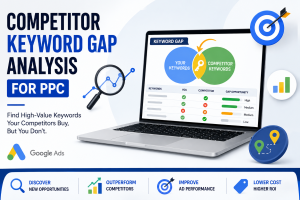
Competitors could be out buying profitable searches that are not in your keyword list. A competitor keyword gap analysis will help you identify those missed opportunities without duplicating or copying the keyword strategy of another advertiser. So, How Do You Do Competitor Keyword Gap Analysis for PPC?
When considering PPC management services, it’s easy to see that the goal is clear: find the search themes that are relevant to your business, predict their commercial potential, and run some tests against the existing real-data source of conversions.
Competitor Keyword Gap Analysis for PPC
1. Identify Your Real Auction Competitors
Start with Google Ads Auction Insights rather than relying only on companies you already know.
The report identifies advertisers participating in the same auctions and provides metrics such as impression share, overlap rate, outranking share, position-above rate, and top-of-page rate. It does not reveal a competitor’s complete keyword list, so use it as a competitor-discovery tool rather than a keyword-export tool. Google currently provides Auction Insights for eligible Search, Shopping, and Performance Max campaigns.
Read more: Will ai replace seo in 2026?
2. Build Competitor-Based Keyword Lists
Open Google Keyword Planner and select Discover new keywords. Enter a competitor’s relevant product, service, or category page instead of relying only on its homepage. Repeat the research using seed phrases that describe the offer.
According to Google Ads, Keyword Planner can generate keyword ideas from words or websites while providing estimated search demand and targeting costs.
Research three to five genuine competitors, combine the exports, remove duplicates, and organize the remaining terms by intent:
- High intent: “hire,” “pricing,” “company,” or “service near me”
- Comparison intent: “best,” “alternative,” or “versus”
- Research intent: “how to,” “guide,” or “examples”
Read more: How to get featured in AI search results?
3. Compare the List With Your Account
Export your current keywords and review the Search Terms report. This step matters because a seemingly missing keyword may already be reached through phrase match, broad match, or a close variation.
Google’s Search Terms report shows the actual searches that triggered your ads and how those searches performed. However, some low-volume queries may be omitted or grouped to protect user privacy.
Classify each competitor term as:
- Already covered
- Genuinely missing
- Irrelevant
- A possible negative keyword
4. Prioritize Gaps by Business Value
Do not prioritize keywords by search volume alone. Score each opportunity according to its relevance, buying intent, estimated cost, likely lead value, landing-page fit, and ability to generate profitable conversions.
Google recommends assigning conversion values so advertisers can measure the business impact of campaigns instead of treating every conversion as equally valuable.
Consider a hypothetical accounting firm targeting “tax accountant.” Competitor research reveals “small business tax planning.” That phrase deserves testing only when the firm offers the service, has a relevant landing page, and can track qualified enquiries.
Get a detailed understanding on seo vs geo here!
5. Test Before Scaling
Add the higher-value gaps to highly targeted ad groups with relevant ads and landing pages. Start with a budget plan and keep track of what people the real search terms are, block traffic from what should not happen, and measure performance based on qualified conversions and return on ad spend, not just clicks.
The real-world application is to consider keyword-gap research as an iterative testing procedure, not just a spreadsheet task.
Common Mistakes to Avoid
Do not duplicate all competitors’ keywords, pursue informational query types without a strategy, overlook landing page relevance, or allocate more budget to pages without conversion tracking measurements implemented yet.
The Bottom Line
How do you do competitor keyword gap analysis for PPC effectively? You need to determine who your competitor-advertisers are, discover popular search phrases that are relevant to them, compare those search phrases to your keywords currently covered, determine the commercial value of each, and test it with an advertiser-controlled campaign.
The best gap isn’t one of the words that you don’t have! It’s a worthwhile search opportunity that your business can profit from.
Read more: How to rank content in chatgpt search results?