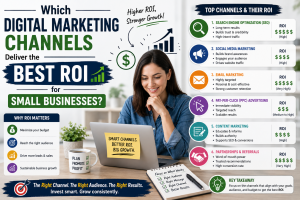
Most small business owners look at digital marketing and see an expensive, complicated machine built for companies with dedicated teams and six-figure budgets. That picture is increasingly inaccurate. The businesses consistently winning online in 2026 are not the ones spending the most money. They are the ones spending it on the right things.
A tight budget is not a disadvantage when it forces you to be deliberate. Large companies spread their marketing spend across every channel whether it is working or not. A small business with limited resources has to pick its spots carefully, which often produces a more focused and measurable strategy than what most enterprises actually run.
This guide covers the highest-return digital marketing activities available to small businesses in 2026, what each one requires, what each one costs in time and money, and how to sequence them so the first investments build the foundation for everything that follows.
Start With What You Can Actually Own: SEO and Content
Paid advertising stops the moment you stop paying for it. SEO and content marketing compound over time. A well-written article that answers a specific question your customers are asking can bring in qualified traffic for months or years without any additional spend. For a small business operating on a limited budget, that time-to-value trade-off matters enormously.
The businesses that built durable online visibility did not do it by outspending competitors on ads. They did it by being consistently useful to the people they wanted to reach. That is still how it works in 2026, and it is still one of the most accessible strategies for any business with limited capital.
Focus on questions, not just keywords
The most common mistake small businesses make with SEO is treating it as a keyword-stuffing exercise. Modern search, including both traditional Google results and the AI-generated summaries that now appear at the top of many searches, rewards content that genuinely answers specific questions in clear, structured language.
Before writing any content, ask what your customers are actually searching for. Not broad terms like your product category, but the specific questions they type when they have a problem you can solve. That shift in thinking changes how you write, what you write about, and how likely your content is to appear when it matters. The relationship between traditional SEO, AI-generated results, and the newer optimization disciplines is worth understanding fully before you commit to a content strategy. The breakdown in SEO vs GEO vs AEO covers exactly how these three approaches differ and which one makes sense for a small business starting from scratch.
Consistency matters more than volume
Small businesses often try to produce a large volume of content in a short period, burn out, and go months without publishing anything. One well-researched, genuinely useful piece of content published every two weeks produces better results than a content burst followed by silence. Search engines and readers both reward consistent publishing schedules over inconsistent ones.
Each piece of content you publish should answer one specific question comprehensively. Not five questions superficially. One question well. That approach creates content that ranks, gets shared, and actually helps the people who find it, which is the only signal that matters for long-term SEO performance.
Local SEO Is the Most Cost-Effective Channel for Most Small Businesses
For any business that serves a specific geographic area, whether that is a neighbourhood, a city, or a region, local SEO delivers a higher return on investment than almost any other digital marketing activity. The reason is intent. Someone searching for your service near them is not browsing. They are ready to buy or contact someone. Appearing in those results puts you directly in front of people at the point of decision.
Google Business Profile is free. Optimising it takes a few hours. Keeping it updated takes minutes per week. That combination of low cost and high intent makes it the single best place for a budget-constrained small business to start their local digital marketing effort.
What a complete Google Business Profile actually requires
Most business profiles are incomplete in ways that cost them visibility. A complete profile includes accurate business hours updated whenever they change, a detailed description written with the language your customers actually use when searching, photos uploaded regularly, a category selection that reflects what you actually do rather than a broad approximation, and responses to every review the business receives.
That last point matters more than most business owners realize. Responding to reviews, including negative ones, is a visible signal of how a business treats its customers. It also creates additional indexed content associated with your business name and location, which strengthens your local search presence over time.
Local citations and directory listings
Every time your business name, address, and phone number appear consistently across a reputable directory, it reinforces your local search signals. The major directories worth prioritizing are Yelp, Apple Maps, Bing Places, and any industry-specific directories relevant to your category. The information needs to be identical across all of them. Inconsistencies in your address format or phone number dilute the signal rather than building it.
Email Marketing Still Delivers the Highest Return Per Dollar Spent
Email marketing consistently produces the highest return on investment of any digital marketing channel, with industry estimates placing it at around 36 dollars returned for every dollar spent. For a small business that cannot afford to test expensive paid campaigns, that ratio makes it the most reliable channel to invest in once you have an audience to email.
The key word is once. Email marketing requires a list, and building that list requires giving people a reason to sign up. That reason needs to be genuinely useful, not a vague promise of updates. A discount on a first purchase, a practical guide relevant to your industry, or early access to something your customers actually want are all mechanisms that convert website visitors into email subscribers.
What to send and how often
The most common email marketing mistake is sending too frequently with content that is promotional rather than useful. Once a week is often too much for a small business that does not have a dedicated content team. Once or twice a month with a genuinely useful email produces better open rates, lower unsubscribe rates, and more actual conversions than a high-frequency promotional approach.
Each email should lead with something the reader finds useful before it asks for anything. A tip relevant to your industry, an answer to a common question, a resource that helps them make a better decision. The ask, whether that is a purchase, a booking, or a referral, comes after you have earned a few seconds of attention by being useful first.
Social Media on a Budget Means Picking One Channel and Doing It Well
The worst social media strategy for a small business is a thin presence across six platforms. Posting inconsistently on LinkedIn, Facebook, Instagram, and TikTok simultaneously produces worse results than a focused, consistent presence on a single platform chosen because that is where your specific customers actually spend time.
For B2B businesses and professional services, LinkedIn tends to produce the highest-quality engagement. For local consumer businesses, Facebook and Instagram still deliver strong results. For businesses whose products or services are visual or demonstrable, short-form video on Instagram Reels or YouTube Shorts has a disproportionate reach-to-effort ratio because the platforms actively distribute that format to people who do not already follow you.
Video content without a production budget
Small businesses consistently overestimate the production quality required for effective social video. A phone camera, decent natural lighting, and someone who genuinely knows the subject delivers more engagement than a professionally produced video where the content is generic. People watch videos that teach them something or show them something they have not seen before, regardless of production quality.
A five-minute video answering the most common question your customers ask creates more trust than any amount of polished promotional content. Record it once, upload it to YouTube, clip it for Instagram, and pin it to the top of your Facebook page. One piece of content, multiple placements, genuine value.
AI Search Is Changing Where Your Customers Find You
Search behaviour in 2026 looks meaningfully different from 2023. A significant and growing portion of people asking questions online are getting answers directly from AI tools like ChatGPT, Google’s AI Overviews, and Perplexity rather than clicking through to individual websites. For small businesses, this is not a reason to panic. It is a reason to understand how these systems decide what to surface and to ensure your content is structured in a way that makes it easy for AI to cite, quote, and recommend.
The question many small business owners are asking is whether traditional SEO still matters at all, or whether AI tools are making it obsolete. The reality is more nuanced than either extreme. Understanding where AI fits into the current search landscape matters before you decide where to focus your content efforts. Will AI Replace SEO in 2026 covers that question directly and explains what the evidence actually shows about how AI and traditional search are coexisting rather than one replacing the other.
How to structure content so AI tools can use it
AI search systems favour content that is specific, clearly structured, and written in direct language that answers a particular question without requiring the reader to wade through extensive context first. That means short paragraphs, clear headings, and answers that appear early in the piece rather than being buried after lengthy introductions. If you want your content to appear in AI-generated summaries and featured results, the guide on how to get featured in AI search results explains the specific structural and content choices that make a meaningful difference to AI visibility for small business content.
ChatGPT and other AI tools as discovery channels
Customers are increasingly asking AI tools for recommendations before they even run a search on Google. A small business that appears in ChatGPT’s responses when someone asks for a recommendation in their category or location has a genuine competitive advantage over businesses that do not. Getting there requires understanding how these systems source and rank content, which is a different question from traditional SEO. How to rank content in ChatGPT search results covers the practical steps a small business can take to improve their visibility in AI tool recommendations, most of which do not require any paid tools or large budgets to implement.
Measure What Actually Matters and Ignore the Rest
One of the most common ways small businesses waste their digital marketing budget is optimizing for metrics that do not connect to revenue. Follower counts, page views, and impression numbers are easy to track and easy to report. They are also largely useless as business metrics unless you can draw a line between them and actual customers or sales.
For a small business, the metrics worth tracking are the ones that tell you how many people contacted you, booked an appointment, made a purchase, or signed up for your email list. Everything upstream of those actions is context. Those actions are the outcome.
Setting up basic tracking without a marketing team
Google Analytics 4 is free and, once set up correctly, shows you which pages on your website are driving contact form submissions, phone calls, and purchases. Google Search Console is also free and shows you which search queries are bringing people to your website, which pages are ranking, and which ones are receiving impressions but not clicks.
These two tools together give a small business more actionable data than most paid analytics platforms. The setup takes a few hours and the ongoing maintenance is minimal. The insight they provide changes how you allocate your time across marketing activities because it shows what is actually working rather than what feels like it is working.
Review your results quarterly, not weekly
Digital marketing results from organic channels take time to develop. A small business that reviews results weekly and changes strategy based on short-term fluctuations will never let any approach build enough momentum to show its true potential. Quarterly reviews give enough time for patterns to emerge, for content to accumulate authority, and for email lists to grow to a size where the data is meaningful.
Sequencing Your Digital Marketing Investment on a Small Budget
The order in which you invest matters as much as the investments themselves. A small business starting from zero should follow a sequence that builds infrastructure before distribution.
Month one and two: get your Google Business Profile complete and optimised, set up Google Analytics and Search Console, and identify the ten questions your customers ask most frequently. Month three and four: write answers to those ten questions as standalone pages or blog posts on your website. Month five and six: build an email signup mechanism and begin collecting addresses from your existing customers. Month seven onwards: choose one social platform and begin posting consistently, using your existing content as the source material.
Each stage builds on the previous one. You are not spreading effort across everything at once. You are building a foundation that makes each subsequent channel more effective because the content, the tracking, and the audience already exist.
Frequently Asked Questions
Q: How much should a small business spend on digital marketing?
Industry benchmarks suggest allocating between 7 and 12 percent of revenue to marketing, but for a small business with a tight budget, the more useful question is which activities produce the highest return for the least spend. Local SEO and content marketing have very low direct costs but require consistent time investment. Email marketing has minimal cost once a list exists. Paid advertising has immediate costs and immediate results but stops the moment spending stops. A small business should prioritize the first two before investing significantly in the third.
Q: What is the single most important digital marketing priority for a small business?
For most small businesses serving a local or regional market, Google Business Profile optimization is the single highest-return starting point. It is free, it directly targets people with purchase intent, and it is frequently overlooked or incomplete by competitors. Beyond that, creating content that answers specific customer questions is the most durable long-term investment a small business can make in its digital presence.
Q: Does social media actually drive sales for small businesses?
Social media drives sales most effectively for businesses that are consistent on a single platform rather than inconsistent across many. It works best as a trust-building tool, not a direct sales channel. People follow businesses they find useful or interesting and eventually buy from them when the need arises. Expecting immediate sales from social media posts typically leads to disappointment. Expecting gradual audience building and eventual conversion over months typically reflects what the channel actually delivers.
Q: How is AI changing digital marketing for small businesses?
AI is changing how customers find businesses before they even reach a search engine. More people are asking AI tools like ChatGPT for recommendations, summaries, and answers to specific questions. Small businesses whose content is well-structured, specific, and written to answer clear questions are more likely to be cited by these tools than businesses with vague or promotional content. This shift does not replace traditional SEO but adds a new layer of visibility that requires different content choices. The comparison between SEO vs GEO vs AEO explains how these disciplines relate to each other and which one deserves priority for a small business starting to think about AI search visibility.
Q: Can a small business rank well on Google without paying for ads?
Yes, consistently. Organic search rankings are earned through relevance, authority, and user experience, none of which require advertising spend. Local businesses with well-optimised Google Business Profiles and consistent NAP citations regularly outrank larger businesses in local search results. Content that genuinely answers specific questions ranks without paid promotion when the topic is specific enough and the competition is manageable. Paid ads can accelerate visibility but they are not a prerequisite for it.
Q: What free tools should every small business use for digital marketing?
Google Analytics 4 for tracking website behaviour and conversion events. Google Search Console for monitoring search performance and identifying content opportunities. Google Business Profile for local search visibility. Mailchimp or a similar platform at its free tier for beginning email list management. Canva at its free tier for creating social graphics without a design budget. These five tools together cover the core needs of a small business digital marketing operation at zero direct cost.
Q: How long does it take for SEO to produce results for a small business?
Realistic timelines for local SEO improvements are between 60 and 90 days for Google Business Profile optimisation effects and between four and six months for content-based organic ranking gains. These timelines assume consistent effort and are not guarantees. Businesses in less competitive local markets often see faster results. Businesses in highly competitive categories may need longer. The compounding nature of SEO means that results typically accelerate over time rather than arriving linearly, so patience through the early months is essential.
Q: How do I get my small business to appear in AI search results?
Appearing in AI-generated search summaries and tool recommendations requires content that is specific, well-structured, and authoritative on the topics relevant to your business. AI systems source their answers from content that clearly and directly addresses particular questions without excessive caveats or vague language. Having your business mentioned in reputable third-party sources, directories, and review platforms also contributes to AI visibility because these systems draw on multiple signals to determine which businesses to recommend. The full breakdown of specific steps is covered in the guide on how to get featured in AI search results.